On Gratitude
Why appreciation changes your relationship with life
NEW YEAR SALE! Annual subscriptions are 50% off until January 1. If you want full access and all upcoming releases, now is the best time to join!
You woke up this morning in a bed. Not on the ground, not on a concrete floor, not shivering under a bridge. You turned on a light without thinking about it, because electricity flowing into your home is so reliable you only notice it when it stops. You probably drank clean water from a tap, something that would have seemed like magic to your ancestors and still seems like magic to billions of people alive right now.
Before you even left your bedroom, you experienced luxuries that emperors couldn’t access two hundred years ago. But did you notice? Did you feel grateful? Or did you immediately start cataloging everything that’s wrong, everything you don’t have, everything that’s not going according to plan?
Most of us are living in conditions our great-grandparents would consider paradise while experiencing levels of dissatisfaction our great-grandparents would find incomprehensible.
This isn’t because modern life is secretly terrible despite its comforts. It’s because we’ve trained ourselves to focus on what’s absent rather than what’s present, on what could be better rather than what already is, on the gap between our current reality and our imagined ideal rather than the gap between our current reality and much worse alternatives.
Gratitude is the practice of reversing this attention. Not by denying that things could be better, not by pretending problems don’t exist, but by consciously recognizing what’s actually here, what’s actually working, what you actually have access to that you didn’t have to earn through any merit of your own.
This practice sounds simple, but it’s not. It requires fighting against your brain’s default programming.
Your mind evolved to scan for threats and problems, not to appreciate what’s going well. Your ancestors who noticed the one thing that could kill them survived. Your ancestors who spent time appreciating the ninety-nine things that were fine often didn’t notice the one thing that was dangerous until it was too late.
This threat-detection system served humans well when survival was constantly at stake. But most of us no longer live in environments where a moment of inattention could mean death. We live in relatively safe, comfortable circumstances where our threat-detection system has nothing real to focus on, so it invents threats.
Your mind will find something to worry about, something to fix, something to be dissatisfied with, because that’s what minds do. If your external circumstances are good, your mind will turn inward and find problems with your body, your relationships, your career trajectory, your past choices, your future prospects.
The quality of your actual circumstances has remarkably little impact on your mind’s determination to find inadequacy somewhere.
This is why wealthy people can be miserable and why people living in genuine hardship can experience moments of profound joy. The external circumstances matter less than we think they do. What matters more is the relationship you have with whatever circumstances you’re experiencing.
Gratitude doesn’t change your circumstances. It changes your relationship with your circumstances.
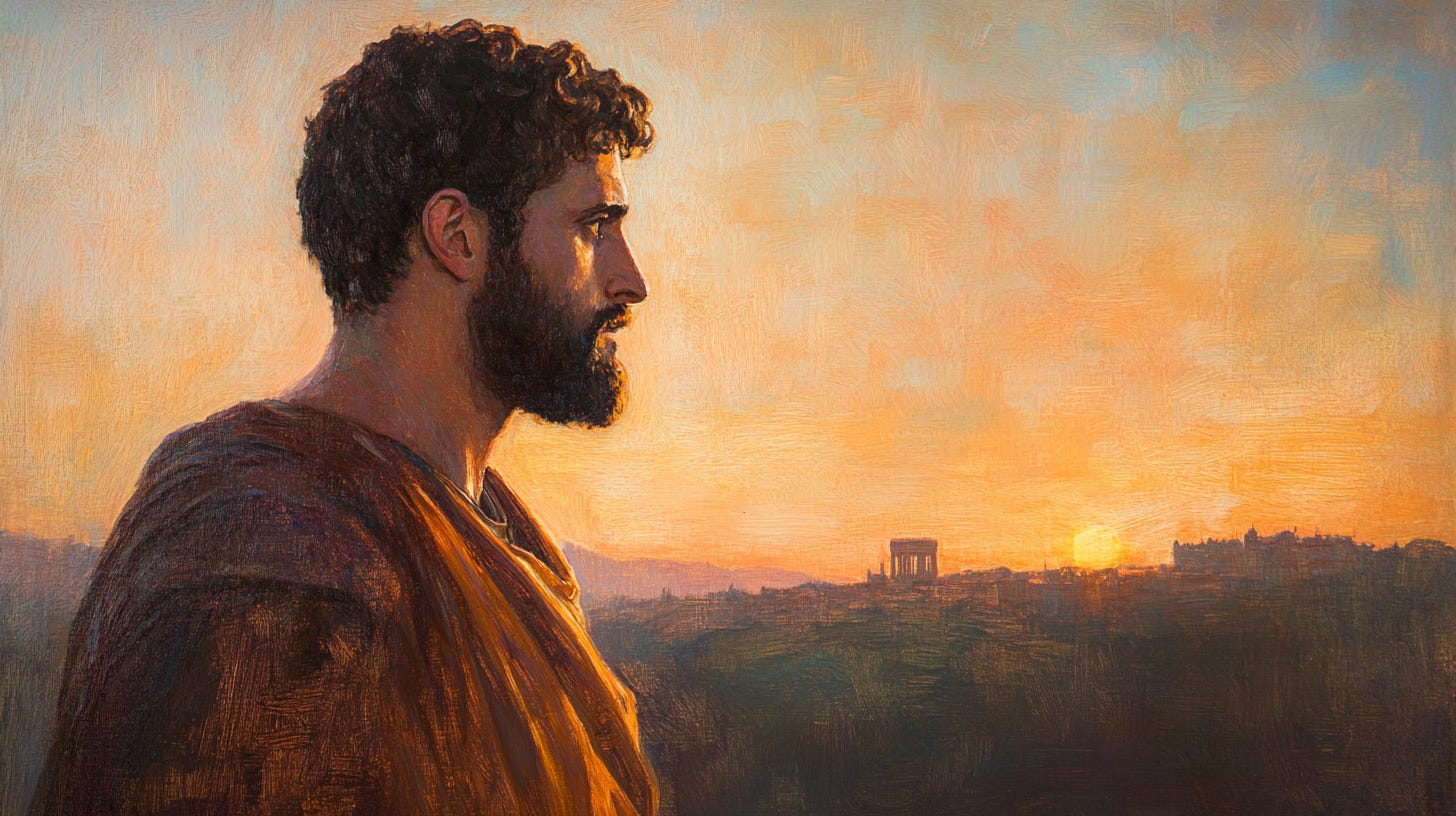
When Marcus Aurelius wrote his meditations, he was dealing with plague, war, betrayal, and the constant pressure of governing an empire. Yet he filled his private writings with reminders to appreciate what he had rather than resent what he lacked. He wrote:
“When you arise in the morning, think of what a precious privilege it is to be alive, to breathe, to think, to enjoy, to love.”
He wasn’t pretending his life was easy. He was choosing to recognize that even a difficult life contains elements worth appreciating. That consciousness itself is extraordinary. That the ability to think, feel, and experience the world is a gift that no amount of difficulty negates.
This wasn’t naive optimism. It was a deliberate practice of directing attention toward what remained valuable even when circumstances were genuinely difficult.
The Stoics understood that you always have a choice about where to place your attention. Not unlimited choice, not complete control, but meaningful choice nonetheless. You can focus on what you lack or what you have. You can dwell on what’s wrong or acknowledge what’s right. You can resent your limitations or appreciate your capacities.
Both perspectives are technically accurate. Your life genuinely contains both problems and blessings, lacks and abundances, difficulties and gifts. Which ones you focus on doesn’t change the facts, but it changes your experience of the facts dramatically.
Consider how this works with something as simple as your morning routine. You can experience brushing your teeth as a tedious chore, one more thing you have to do before you can start your actual day. Or you can experience it as evidence that you have teeth to brush, access to clean water, a home with a bathroom, time to take care of yourself, and the cognitive function to remember to perform basic self-care.
The facts haven’t changed. Your teeth are the same teeth, the water is the same water, the routine is the same routine. But your relationship with those facts shifts completely depending on where you place your attention.
This shift might seem trivial when applied to teeth brushing, but the principle scales to everything in your life. Your job can be experienced as soul-crushing drudgery or as the means by which you house and feed yourself. Your body can be experienced as a collection of flaws or as the vehicle through which you experience existence. Your relationships can be experienced as sources of disappointment or as evidence that you’re not alone in the world.
The circumstances remain the same. Your experience of them transforms based on what you choose to emphasize.
But gratitude isn’t just about feeling better. It’s about seeing more accurately.
When you focus exclusively on what’s wrong, you’re not seeing reality clearly. You’re seeing a filtered version of reality where the problems are amplified and the blessings are invisible. When you practice gratitude, you’re not putting on rose-colored glasses. You’re taking off the dark glasses you didn’t realize you were wearing.
The world contains both difficulty and beauty, both suffering and joy, both problems and gifts. Gratitude is the practice of seeing the full picture rather than just the portion your threat-detection system automatically highlights.
Seneca wrote extensively about the relationship between gratitude and contentment. He observed that people spend their lives chasing more, convinced that satisfaction lies in the next achievement, the next acquisition, the next experience. But satisfaction never arrives because the goal posts keep moving.
You think you’ll be satisfied when you get the promotion, but once you get it, you’re already focused on the next level. You think you’ll be content when you reach a certain income, but once you reach it, your expenses expand to match and you feel just as stretched as before. You think you’ll be happy when you find the right relationship, but once you find it, you start noticing its imperfections.
This isn’t because your goals were wrong. It’s because satisfaction doesn’t come from acquiring what you don’t have. It comes from appreciating what you already have.
Seneca argued that the wealthy person isn’t the one with the most possessions but the one who needs the least. The person who can look at their current circumstances and feel genuine appreciation has achieved something that no amount of acquisition can provide: sufficiency.
This doesn’t mean you shouldn’t work to improve your circumstances or pursue meaningful goals. It means that if you can’t feel gratitude for what you currently have, you won’t feel gratitude for what you acquire next. The problem isn’t what you have. The problem is your relationship with having.
As we approach the end of another year, with holidays that traditionally emphasize gratitude and togetherness, notice how your mind relates to this season. Does it focus on the people gathered around you or the people who are absent? Does it appreciate the meal in front of you or resent that it’s not exactly what you wanted? Does it recognize the privilege of time off or stress about all the obligations?
The season hasn’t changed. Your life circumstances are what they are. But your experience of both the season and your circumstances is entirely dependent on where you choose to direct your attention.
This choice is available not just during holidays but every single day. Every morning you wake up, you’re making a decision about how to relate to your life. You can begin by cataloging everything that’s wrong, everything that needs to be fixed, everything that’s not measuring up to your expectations. Or you can begin by acknowledging what’s present, what’s working, what you have access to that you didn’t have to earn.
Neither approach changes the facts. But one approach makes your life feel like a constant emergency that you’re failing to adequately address. The other approach makes your life feel like a complex situation you’re navigating with whatever resources you currently possess.
The Stoics practiced what they called “negative visualization,” which involved regularly imagining losing what they had. Not to make themselves miserable, but to appreciate what they had while they still had it. They understood that humans quickly adapt to their circumstances, that today’s luxury becomes tomorrow’s expectation, that appreciation fades unless it’s deliberately maintained.
When you imagine losing your health, you appreciate the body you have right now, even with its limitations. When you imagine losing your home, you appreciate the shelter you currently take for granted. When you imagine losing the people in your life, you appreciate their presence while they’re still here.
This practice isn’t morbid. It’s realistic. Everything you have is temporary. Everyone you love will eventually be gone, or you will. The question is whether you’ll appreciate what you have while you have it, or whether you’ll only recognize its value in retrospect.
Most people spend their lives postponing gratitude, waiting until circumstances improve before they allow themselves to feel satisfied. But circumstances never improve enough to trigger automatic gratitude. There’s always something more to want, something more to fix, something more to worry about.
The only way to experience gratitude is to practice it now, with things as they are, including all the problems and imperfections and difficulties that come with being alive.
This practice doesn’t require perfect circumstances. It requires the willingness to notice what’s present alongside what’s absent, what’s working alongside what’s broken, what you have alongside what you lack.
You have consciousness. You have this moment. You have the capacity to think, feel, and choose how you relate to your experience. You have access to comforts and technologies that would seem miraculous to humans throughout most of history. You have problems, yes, but you also have resources for addressing those problems that most people throughout human history never had.
These facts don’t solve your problems. They don’t eliminate your difficulties. They don’t make your life perfect. But they’re true, and they’re worth acknowledging.
Gratitude is the practice of acknowledging what’s true about your life beyond just the problems. It’s the practice of seeing the full picture rather than just the portion your mind automatically emphasizes. It’s the practice of relating to your circumstances with appreciation for what they include rather than just resentment for what they exclude.
This practice changes everything about how you experience being alive. Not by changing your circumstances, but by changing your relationship with whatever circumstances you’re experiencing.
📝 Today’s Stoic Gameplan
Morning acknowledgment: Before you check your phone or start your mental to-do list, name three things present in your immediate environment that make your life easier or more comfortable than it could be.
Appreciate the ordinary: Choose one routine activity today (showering, eating, walking) and consciously notice what would need to be different for that activity to be impossible. Appreciate that it’s possible.
Practice negative visualization: Spend two minutes imagining losing something you currently take for granted (health, home, a person, a capability). Then notice how you feel about having it right now.
Evening reflection: Before sleep, identify one difficult thing about today and one thing that went well or that you have access to. Write both down. Notice which one your mind naturally emphasized throughout the day.
Gratitude isn’t about pretending everything is perfect. It’s about acknowledging that even imperfect lives contain elements worth appreciating. That even difficult circumstances include some blessings. That consciousness itself, with all its problems and possibilities, is extraordinary.
The question isn’t whether your life is perfect. It’s whether you can appreciate what it includes while working to improve what needs improving.
As this year ends and another begins, as you gather with people or miss people or navigate whatever circumstances you’re facing, practice gratitude. Not as performance, not as obligation, but as the simple act of noticing what’s actually present in your life alongside everything that’s absent.
This noticing won’t solve your problems. But it will change your relationship with your life in ways that solving all your problems never could.
Happy holidays and stay stoic,
SW
NEW YEAR SALE! Annual subscriptions are 50% off until January 1. If you want full access and all upcoming releases, now is the best time to join!


I really got a lot from reading your essay on gratitude this morning. I have studied stoicusm a bit and believe its realistic perspective on the world, including but certainly not limited ti practicing gratitude, can help us find a better way to navigate the modern world, just as it helped ancients navigate that world. Thank you fir writing such a thoughtful, helpful piece. I will become a member in the near future.
my ancestors created ancient Peru. he is wrong